NOVEDADES












3,995
2,996
THE NEW YORK TIMES. CULTURED TRAVELER
Some travelers dig deep, with a sharp appetite for knowledge and minds wide open to what’s old and what’s new. In Cultured Traveler, the latest in the travel book collaborations between The New York Times and TASCHEN, these adventurers hum to Mozart in Vienna and tap their toes to dance music in Dar es Salaam. They pursue Hamlet in Elsinore, Picasso on the French Riviera, and Le Corbusier in India. They follow in the footsteps of Georgia O’Keeffe, Jackie Kennedy, and even Jesus.
3,995
2,996

1,250
938
THE NOTEBOOK
At thirty-one, Noah Calhoun, back in coastal North Carolina after World War II, is haunted by images of the girl he lost more than a decade earlier. At twenty-nine, socialite Allie Nelson is about to marry a wealthy lawyer, but she cannot stop thinking about Noah. Thus begins the story of a love so enduring and deep it can turn tragedy into triumph, and may even have the power to create a miracle...
Every so often a love story so captures our hearts that it becomes more than a story—it becomes an experience to remember forever. The Notebook is such a book. It is a celebration of how passion can be ageless and timeless, a tale that moves us to laughter and tears and makes us believe in true love all over again...
1,250
938

1,250
938
THE OMEGA FACTOR
When Nick travels to Belgium for a visit with a woman from his past, he unwittingly stumbles on the trail of a legendary panel from the Ghent Altarpiece, stolen in 1934 under cover of night and never seen since. Soon Nick is plunged into a bitter conflict, one that has been simmering for nearly two thousand years. On one side is the Maidens of Saint-Michael, les Vautours—the Vultures—a secret order of nuns and the guardians of a great truth. Pitted against them is the Vatican, which has wanted for centuries to both find and possess what the nuns guard. Because of Nick the maidens have finally been exposed, their secret placed in dire jeopardy—a vulnerability that the Vatican swiftly moves to exploit utilizing an ambitious cardinal and a corrupt archbishop, both with agendas of their own.
1,250
938

1,350
1,013
THE ORIGINAL DAUGHTER
Before Arin, Genevieve Yang was an only child. Living with her parents and grandmother in a single-room flat in working-class Bedok, Genevieve is saddled with an unexpected sibling when Arin appears, the shameful legacy of a grandfather long believed to be dead. As the two girls grow closer, they must navigate the intensity of life in a place where the urgent insistence on achievement demands constant sacrifice. Knowing that failure is not an option, the sisters learn to depend entirely on one another as they spurn outside friendships, leisure, and any semblance of a social life in pursuit of academic perfection and passage to a better future.
When a stinging betrayal violently estranges Genevieve and Arin, Genevieve must weigh the value of ambition versus familial love, home versus the outside world, and allegiance to herself versus allegiance to the people who made her who she is.
1,350
1,013
1,995
1,496
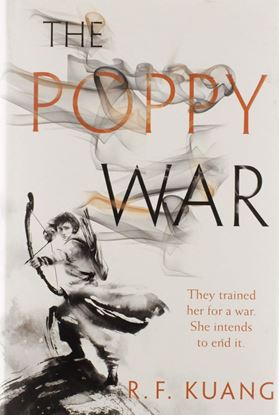
THE POPPY WAR (1) (HC)
When Rin aced the Keju—the Empire-wide test to find the most talented youth to learn at the Academies—it was a shock to everyone: to the test officials, who couldn’t believe a war orphan from Rooster Province could pass without cheating; to Rin’s guardians, who believed they’d finally be able to marry her off and further their criminal enterprise; and to Rin herself, who realized she was finally free of the servitude and despair that had made up her daily existence. That she got into Sinegard—the most elite military school in Nikan—was even more surprising.
But surprises aren’t always good.
Because being a dark-skinned peasant girl from the south is not an easy thing at Sinegard. Targeted from the outset by rival classmates for her color, poverty, and gender, Rin discovers she possesses a lethal, unearthly power—an aptitude for the nearly-mythical art of shamanism. Exploring the depths of her gift with the help of a seemingly insane teacher and psychoactive substances, Rin learns that gods long thought dead are very much alive—and that mastering control over those powers could mean more than just surviving school.
1,995
1,496
1,450
1,088
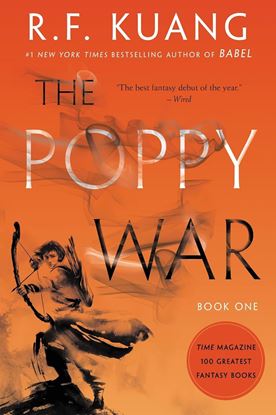
THE POPPY WAR (1) (PB)
When Rin aced the Keju—the Empire-wide test to find the most talented youth to learn at the Academies—it was a shock to everyone: to the test officials, who couldn’t believe a war orphan from Rooster Province could pass without cheating; to Rin’s guardians, who believed they’d finally be able to marry her off and further their criminal enterprise; and to Rin herself, who realized she was finally free of the servitude and despair that had made up her daily existence. That she got into Sinegard—the most elite military school in Nikan—was even more surprising.
But surprises aren’t always good.
Because being a dark-skinned peasant girl from the south is not an easy thing at Sinegard. Targeted from the outset by rival classmates for her color, poverty, and gender, Rin discovers she possesses a lethal, unearthly power—an aptitude for the nearly-mythical art of shamanism. Exploring the depths of her gift with the help of a seemingly insane teacher and psychoactive substances, Rin learns that gods long thought dead are very much alive—and that mastering control over those powers could mean more than just surviving school.
For while the Nikara Empire is at peace, the Federation of Mugen still lurks across a narrow sea. The militarily advanced Federation occupied Nikan for decades after the First Poppy War, and only barely lost the continent in the Second. And while most of the people are complacent to go about their lives, a few are aware that a Third Poppy War is just a spark away . . .
Rin’s shamanic powers may be the only way to save her people. But as she finds out more about the god that has chosen her, the vengeful Phoenix, she fears that winning the war may cost her humanity . . . and that it may already be too late.
1,450
1,088