
995
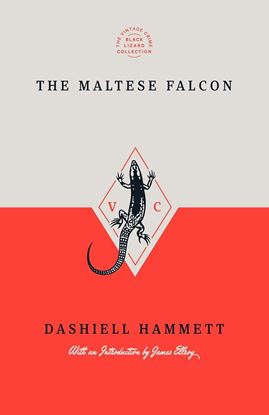
THE MALTESE FALCON (SPECIAL ED.) (PB)
A treasure worth killing for. Sam Spade, a slightly shopworn private eye with his own solitary code of ethics. A perfumed grafter named Joel Cairo, a fat man name Gutman, and Brigid O’Shaughnessy, a beautiful and treacherous woman whose loyalties shift at the drop of a dime. These are the ingredients of Dashiell Hammett's iconic, influential, and beloved The Maltese Falcon.
995

2,600
THE GODFATHER (DELUXE EDITION)
Since its release in 1969, The Godfather has made an indelible mark on American crime fiction. From the mind of master storyteller Mario Puzo, it traces the Corleone family, whose brilliant and brutal portrayal illuminated the violent and seductive allure of power in American society. A tale of family and loyalty, law and order, obedience and rebellion, it has stood the test of time as the definitive novel of the Mafia underworld.
2,600
995
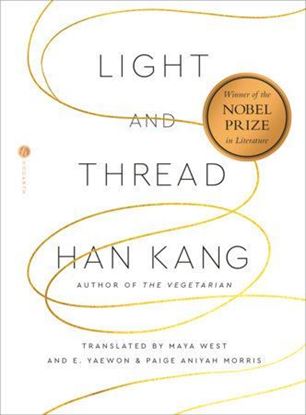
LIGHT AND THREAD
In this light-filled and multi-faceted book, Han Kang draws together the threads of her work and life, tracing the connections between her interior and exterior worlds through a sequence of essays, poems, photographs, and diaries, brilliantly translated by Maya West and e. yaewon & Paige Aniyah Morris.
A book of reflections, of words and light, it has at its heart the tiny, north-facing courtyard garden at her home, cultivated solely through the reflected sunlight of the mirrors which she must move throughout the day, as the earth turns on its axis.
In a poem written at eight years old, Han Kang imagined a “gold thread” of connection—an idea which she explores here with luminous attention, beginning with her Nobel Lecture. She writes of the wonder of following the thread we call language into the depths of other hearts, and her profound sense of an electric current which joins writer and reader.
Both intimate and illuminating, Light and Thread is a book for all readers of Han Kang’s unique body of work.
995
1,200
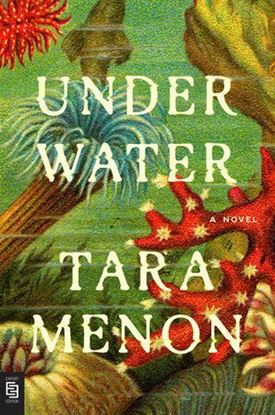
UNDER WATER
After Marissa loses her mother at six, the most intimate relationship of her life begins. Her marine biologist father, determined to channel his grief into completing his wife’s research, whisks her across the globe to Thailand. There she meets Arielle, and a fairytale friendship takes hold. During the week, the girls live at the resort owned by Arielle’s parents; on the weekends they join the tight-knit community of researchers on a nearby island. Together the girls discover the fragile wonders of its reefs, forests, and beaches. Together they learn to dive into the deep, holding their breath for minutes at a time, as effortlessly synchronized as the manta rays they come to know by name. Together they learn to swim their way out of danger. But then comes a wave Arielle can’t outpace, leaving Marissa gutted with loss.
1,200
900
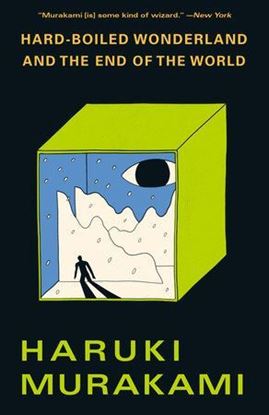
HARD-BOILED WONDERLAND AND THE END OF T.
Across two parallel narratives, Murakami draws readers into a mind-bending universe in which Lauren Bacall, Bob Dylan, a split-brained data processor, a deranged scientist, his shockingly undemure granddaughter, and various thugs, librarians, and subterranean monsters collide to dazzling effect. What emerges is a hyperkinetic novel that is at once hilariously funny and a deeply serious meditation on the nature and uses of the mind.
900
650
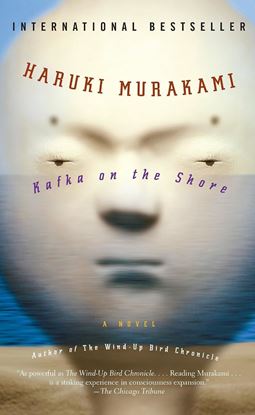
KAFKA ON THE SHORE
Kafka on the Shore is powered by two remarkable characters: a teenage boy, Kafka Tamura, who runs away from home either to escape a gruesome oedipal prophecy or to search for his long missing mother and sister; and an aging simpleton called Nakata, who never recovered from a wartime affliction and now is drawn toward Kafka for reasons that, like the most basic activities of daily life, he cannot fathom.
As their paths converge, and the reasons for that convergence become clear, Haruki Murakami enfolds readers in a world where cats talk, fish fall from the sky, and spirits slip out of their bodies to make love or commit murder. Kafka on the Shore display one of the world's great story tellers at the peak of his powers.
650
850
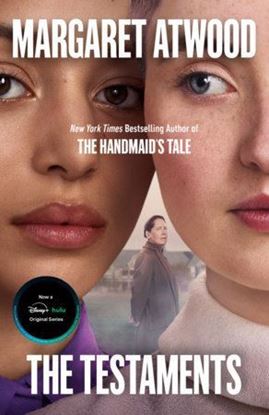
THE TESTAMENTS
More than fifteen years after the events of The Handmaid’s Tale, the theocratic regime of the Republic of Gilead maintains its grip on power, but there are signs it is beginning to rot from within. At this crucial moment, the lives of three women converge, with potentially explosive results. Two have grown up as part of the first generation to come of age in the new order. The testimonies of these two young women are joined by that of Aunt Lydia, whose complex past and uncertain future unfold in surprising and pivotal ways.
With The Testaments, Margaret Atwood opens up the innermost workings of Gilead, as each woman is forced to come to terms with who she is and how far she will go for what she believes.
850
800
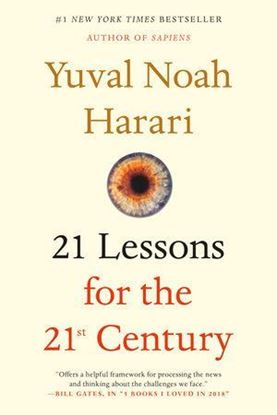
21 LESSONS FOR THE 21ST CENTURY
How can we protect ourselves from nuclear war or ecological catastrophe? What do we do about the epidemic of fake news or the threat of terrorism? How should we prepare our children for the future?
21 Lessons for the 21st Century is a probing and visionary investigation into today’s most urgent issues as we move into the future. As technology advances faster than our understanding of it, hacking becomes a tactic of war, and the world feels more polarized than ever, Harari addresses the challenge of navigating life in the face of constant and disorienting change and raises the important questions we need to ask ourselves in order to survive.
In twenty-one accessible chapters that are both provocative and profound, Harari untangles political, technological, social, and existential issues and offers advice on how to prepare for a very different future from the world we now live in: How can we retain freedom of choice when Big Data is watching us? What will the future workforce look like, and how should we ready ourselves for it? Why is liberal democracy in crisis?
Harari’s unique ability to make sense of where we have come from and where we are going has captured the imaginations of millions of readers. Here he invites us to consider values, meaning, and personal engagement in a world full of noise and uncertainty. When we are deluged with irrelevant information, clarity is power. Presenting complex contemporary challenges clearly and accessibly, 21 Lessons for the 21st Century is essential reading.
800
995
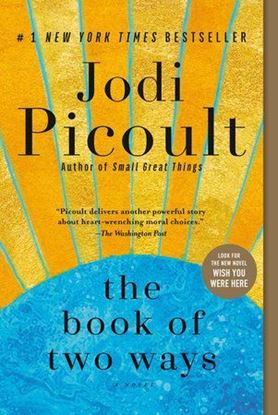
THE BOOK OF TWO WAYS
Everything changes in a single moment for Dawn Edelstein. She’s on a plane when the flight attendant makes an announcement: Prepare for a crash landing. She braces herself as thoughts flash through her mind. The shocking thing is, the thoughts are not of her husband but of a man she last saw fifteen years ago: Wyatt Armstrong.
Dawn, miraculously, survives the crash, but so do all the doubts that have suddenly been raised. She has led a good life. Back in Boston, there is her husband, Brian, their beloved daughter, and her work as a death doula, in which she helps ease the transition between life and death for her clients.
But somewhere in Egypt is Wyatt Armstrong, who works as an archaeologist unearthing ancient burial sites, a career Dawn once studied for but was forced to abandon when life suddenly intervened. And now, when it seems that fate is offering her second chances, she is not as sure of the choice she once made.
995
1,350
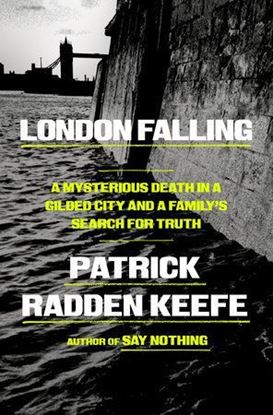
LONDON FALLING
In the early morning of November 29th, 2019, surveillance cameras at the headquarters of MI6, Britain’s spy agency, captured video of a young man pacing back and forth on a high balcony of Riverwalk, a luxury tower on the bank of the river Thames. At 2:24 a.m., he jumped into the river.
In a quiet London neighborhood several miles away, Rachelle Brettler was worried about her son. Zac had told her that he had gone to stay with a friend for the weekend, but then he did not come home. Days later, a police car pulled up and two officers relayed the dreadful news: Her son was dead.
In their unbearable grief, Rachelle and her husband, Matthew, struggled to understand what had happened to Zac. He had had his troubles, but in no way seemed suicidal. As they would soon discover, however, there was a lot they did not know about their son. Only after his death did they learn that he had adopted a fictitious alter ego: Zac Ismailov, son of a Russian oligarch and heir to a great fortune. Under this guise, Zac had become entangled with a slippery London businessman named Akbar Shamji and a murderous gangster known as Indian Dave. As the Brettlers set about investigating their son’s death, they were pulled into a different and more dangerous London than the one they’d always known, and came to believe that something much more nefarious than a suicide had claimed Zac’s life. But to their immense frustration, Scotland Yard seemed unable—or unwilling—to bring the perpetrators to justice.
1,350