1,900
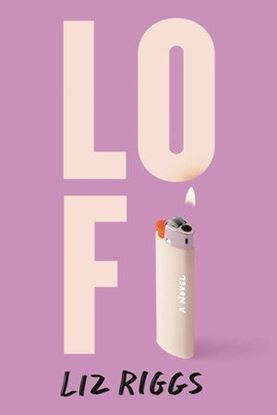
LO FI
Most nights, you’ll find Alison Hunter at The Venue, the kind of sweaty Nashville spot that’s on the circuit for bands like Bon Iver and Death Cab. Sounds glamorous—but not for Al, who stamps hands at the door with Julien, the quiet coworker who treats her like a little sister. When she can sneak off, she bums drinks from the tattooed bartender and watches the bands, wondering if she’ll ever finish a song of her own after her disastrous attempt to play in public.
When a once-in-a-century storm hits and her lead singer ex-boyfriend shows up at the door, Al finds herself stuck in a perpetual cycle of late nights, new flings, and old flames. Obsessed with the disappearance of a troubled indie star, she slowly starts to lose it herself—until one reckless night threatens to derail everything. As propulsive and sexy as the rasp of a static-driven amp, Lo Fi is an openhearted tribute to the messy truth of the creative life, the clash of lust and love, and the yearning to be heard.
1,900
1,350
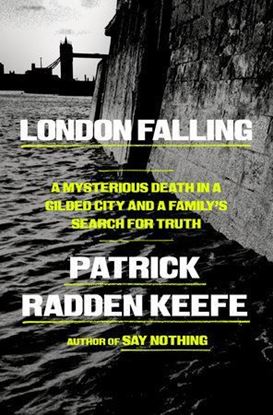
LONDON FALLING
In the early morning of November 29th, 2019, surveillance cameras at the headquarters of MI6, Britain’s spy agency, captured video of a young man pacing back and forth on a high balcony of Riverwalk, a luxury tower on the bank of the river Thames. At 2:24 a.m., he jumped into the river.
In a quiet London neighborhood several miles away, Rachelle Brettler was worried about her son. Zac had told her that he had gone to stay with a friend for the weekend, but then he did not come home. Days later, a police car pulled up and two officers relayed the dreadful news: Her son was dead.
In their unbearable grief, Rachelle and her husband, Matthew, struggled to understand what had happened to Zac. He had had his troubles, but in no way seemed suicidal. As they would soon discover, however, there was a lot they did not know about their son. Only after his death did they learn that he had adopted a fictitious alter ego: Zac Ismailov, son of a Russian oligarch and heir to a great fortune. Under this guise, Zac had become entangled with a slippery London businessman named Akbar Shamji and a murderous gangster known as Indian Dave. As the Brettlers set about investigating their son’s death, they were pulled into a different and more dangerous London than the one they’d always known, and came to believe that something much more nefarious than a suicide had claimed Zac’s life. But to their immense frustration, Scotland Yard seemed unable—or unwilling—to bring the perpetrators to justice.
1,350
995
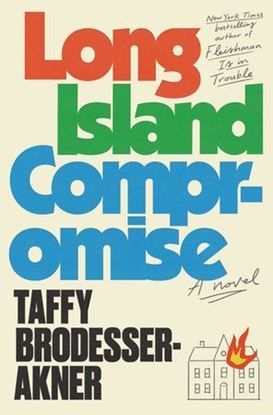
LONG ISLAND COMPROMISE
“Were we gangsters? No. But did we know how to start a fire?”
In 1980, a wealthy businessman named Carl Fletcher is kidnapped from his driveway, brutalized, and held for ransom. He is returned to his wife and kids less than a week later, only slightly the worse, and the family moves on with their lives, resuming their prized places in the saga of the American dream, comforted in the realization that though their money may have been what endangered them, it is also what assured them their safety.
But now, nearly forty years later, it’s clear that perhaps nobody ever got over anything, after all. Carl has spent the ensuing years secretly seeking closure to the matter of his kidnapping, while his wife, Ruth, has spent her potential protecting her husband’s emotional health. Their three grown children aren’t doing much better: Nathan’s chronic fear won’t allow him to advance at his law firm; Beamer, a Hollywood screenwriter, will consume anything—substance, foodstuff, women—in order to numb his own perpetual terror; and Jenny has spent her life so bent on proving that she’s not a product of her family’s pathology that she has come to define it. As they hover at the delicate precipice of a different kind of survival, they learn that the family fortune has dwindled to just about nothing, and they must face desperate questions about how much their wealth has played a part in both their lives’ successes and failures.
995
1,250
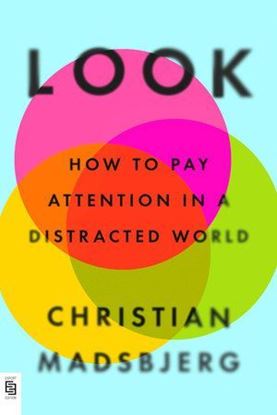
LOOK. HOW TO PAY ATTENTION IN A DISTRACT
A powerful exploration of how we pay attention that will transform the ways we connect with one another – at home, at work, and beyond.
Paying attention is a crucial human skill, yet many of us have forgotten how to listen carefully and observe intentionally. Deluged by social media and hobbled by the increasing social isolation it fosters, we need to rediscover the deeply human ways we connect with others.
1,250
1,350
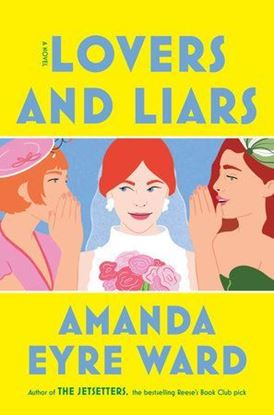
LOVERS AND LIARS
Once upon a time, the Peacock sisters were little girls who combed each other’s tangled hair. But decades of secrets have led them to separate lives—and to telling lies, to themselves and to one another.
Sylvie is getting married. Again. A librarian and widow who soothes her grief by escaping into books (and shelving them perfectly), Sylvie has caught the attention of an unlikely match: Simon Rampling, a mysterious, wealthy man from Northern England. Sylvie allows herself to imagine a life beside him—one filled with the written word, kindness, and companionship. She’s ready to love again . . . or is she?
Cleo is the golden child. A successful criminal defense lawyer with the perfect boyfriend, she is immediately suspicious of Simon. Is he really who he says he is? Cleo heads to Mumberton Castle with a case of investigative files, telling herself she will expose Simon and save her sister from more heartbreak . . . but who is she really trying to save?
Emma is living a lie. She can’t afford this fancy trip—and she definitely can’t tell her husband and sons why. She once dreamed of a line of her own perfumes. Fragrances allowed her to speak in silence. Now, that tendency for silence only worsens her situation. Will she emerge with her dignity and family intact?
When their toxic mother shows up, the sisters assume the roles they fell into to survive their childhood . . . but they just might find the courage to make new choices.
Set over a spectacularly dramatic weekend, in the grand halls of a sprawling castle estate—amid floor-to-ceiling libraries, falconry lessons, and medieval meals—Lovers and Liars is the unforgettable story of a family’s ability to forgive and to find joy in one another once again.
1,350

900
MANSFIELD PARK
Mansfield Park encompasses not only Jane Austen’s great comedic gifts and her genius as a historian of the human animal, but her personal credo as well—her faith in a social order that combats chaos through civil grace, decency, and wit.
At the novel’s center is Fanny Price, the classic “poor cousin,” brought as a child to Mansfield Park by the rich Sir Thomas Bertram and his wife as an act of charity. Over time, Fanny comes to demonstrate forcibly those virtues Austen most admired: modesty, firm principles, and a loving heart. As Fanny watches her cousins Maria and Julia cast aside their scruples in dangerous flirtations (and worse), and as she herself resolutely resists the advantages of marriage to the fascinating but morally unsteady Henry Crawford, her seeming austerity grows in appeal and makes clear to us why she was Austen’s own favorite among her heroines.
900