

1,350
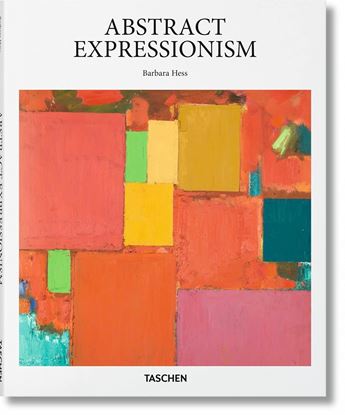
ABSTRACT EXPRESSIONISM (BA-ARCH) (GB)
Hailed as the first American-born art movement to have a worldwide influence, Abstract Expressionism denotes the non-representational use of paint as a means of personal expression. It emerged in America in the 1940s, with lead protagonists including Jackson Pollock, Philip Guston, Robert Motherwell, Mark Rothko, and Willem de Kooning.
Abstract Expressionism spawned many different stylistic tendencies but two particularly prominent sub-categories: action painting, exemplified by de Kooning and Pollock, and color field painting, made most famous by Rothko. Throughout, Abstract Expressionists strove to convey emotions and ideas through the making of marks, through forms, textures, shades, and the particular quality of brushstrokes. The movement favored large-scale canvases, and embraced the role of accident or chance.
With featured works from 20 key Abstract Expressionist artists, this book introduces the movement which shifted the center of art gravity from Paris to New York and remains for many the golden moment of American art.
1,350
1,350
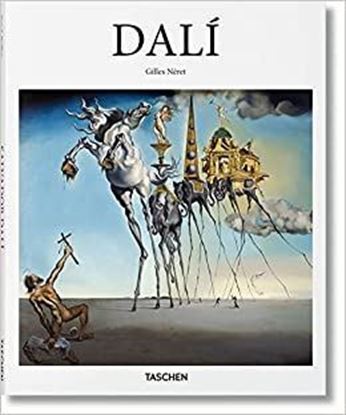
DALI (BA-ART) (GB)
Painter, sculptor, writer, filmmaker, and all-round showman Salvador Dalí (1904–1989) was one of the 20th century’s greatest exhibitionists and eccentrics. One of the first artists to apply the insights of Freudian psychoanalysis to art, he is celebrated in particular for his surrealist practice, with such conceits as the soft watches or the lobster telephone, now hallmarks of the surrealist enterprise, and of modernism in general.
Dalí frequently described his paintings as “hand-painted dream photographs.” Their tantalizing tension and interest resides in the precise rendering of bizarre elements and incongruous arrangements. As Dalí himself explained, he painted with “the most imperialist fury of precision,” but only “to systematize confusion and thus to help discredit completely the world of reality.”
Revolutionizing the role of the artist, the mustache-twirling Dalí also had the intuition to parade a controversial persona in the public arena and, through printmaking, fashion, advertising, writing, and film, to create work that could be consumed and not just contemplated on a gallery wall.
1,350
1,350
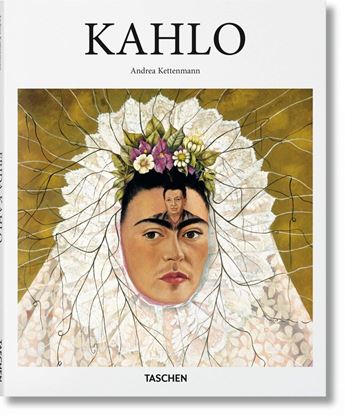
FRIDA KAHLO (BA-ART) (GB)
The arresting pictures of Frida Kahlo (1907–54) were in many ways expressions of trauma. Through a near-fatal road accident at the age of 18, failing health, a turbulent marriage, miscarriage and childlessness, she transformed the afflictions into revolutionary art.
In literal or metaphorical self-portraiture, Kahlo looks out at the viewer with an audacious glare, rejecting her destiny as a passive victim and rather intertwining expressions of her experience into a hybrid real-surreal language of living: hair, roots, veins, vines, tendrils and fallopian tubes. Many of her works also explore the Communist political ideals which Kahlo shared with her husband Diego Rivera. The artist described her paintings as “the most sincere and real thing that I could do in order to express what I felt inside and outside of myself.”
This book introduces the rich body of Kahlo’s work to explore her unremitting determination as an artist, and her significance as a painter, feminist icon, and a pioneer of Latin American culture.
1,350
1,350
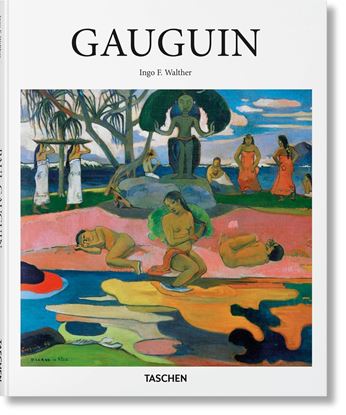
GAUGUIN (BA-ART)
Paul Gauguin (1848-1903) no estaba hecho para las finanzas. Tampoco duró mucho en la marina francesa, ni como vendedor de carpas en Copenhaugue porque no sabía hablar danés. Empezó a pintar en su tiempo libro en 1873. y en 1876 participó en el Salón de París. Tres años después, exponia junto a Pissarro, Degas y Monet. Vehemente y gran bebedor, Gauguin solía autoadjetivarse como «salvaje». Su íntima pero agitada amistad con el también temperamental Vincet van Gogh llegó a su clímax con un incidente violento en 1888, cuando Van Gogh se enfrentó supuestamente a Gauguin con una navaja de afeitar y más tarde se cortó la oreja. Poco después, tras completar una de sus obras maestras, La visión tras el sermón (1888), Gauguin se trasladó a Tahití con la intención de escaparse de «todo lo artificial y convencional» del mundo.
1,350
1,350
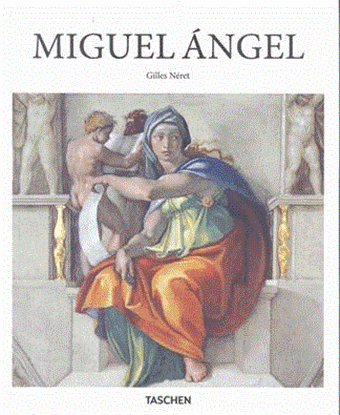
MIGUEL ANGEL (BA-ART) (ES)
Michelangelo di Lodovico Buonarroti Simoni (1475-1564), nacido en la localidad italiana de Caprese (Toscana), fue un hombre del Renacimiento, atormentado y temeroso de Dios, con un talento prodigioso. Sus múltiples logros en pintura, escultura, arquitectura, poesía e ingeniería combinaron cuerpo, espíritu y religiosidad en visionarias obras de arte que cambiaron para siempre la historia del arte. El famoso biógrafo Giorgio Vasari lo situó en la cúspide del Ranacimiento. Sus coetáneos lo llamaban simplemente il divino (el divino). Este libro proporciona una detallada introducción sobre Miguel Ángel y todas sus formidables obras maestras, sin colas ni multitudes. A través de magníficas ilustraciones y textos accesibles, se exploran la extraordinaria figuración del artista y su famoso estilo de la terribilitá (grandeza trascendental), que permitió la representación del drama humano y bíblico con una escala y fervor irresistibles. Con un recorrido por los centros de poder de la Italia del Renacimiento, analizamos sus principales encargos y su excepcional capacidad para crear composiciones espaciales, ya sea en la famosa Biblioteca Laurenziana en Florencia o en la Capilla Sixtina, en el Vaticano, cuya bóveda y testero lucen los extraordinarios frescos (1508-1512) del artista. Desde el formidable David hasta el desgarrador dolor y la fe de la Pietá o el vívido drama del Juicio Final de la Capilla Sixtina, este libro constituye una breve pero rigurosa introducción a un verdadero gigante de la historia del arte y a algunas de las obras de arte más faosas del mundo.
1,350
1,350
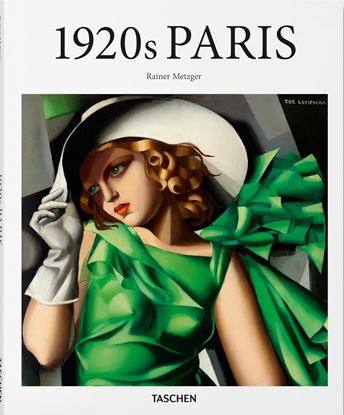
PARIS 1920S (BA) (GB)
Paris is the City of Light in all its facets. In the 1920s La Ville des lumières gleams especially bright and becomes a magnet for creative people from around the world. This is the decade of Coco Chanel and Josephine Baker, Art Deco and Surrealism, café culture and cabaret. The most famous artists of the epoch, later called Classic Modernism, are in close contact and have lively exchanges with one another – including Marcel Duchamp, Francis Picabia, Pablo Picasso, René Clair, Sonia Delaunay, André Breton, Paul Éluard, Max Ernst and Salvador Dalí. The creative life and all its excesses flourish bohème is the word for this way of living. Composers like Igor Stravinsky, writers like James Joyce or Ernest Hemingway and exiles from Eastern Europe like Constantin Brancusi or Marc Chagall enrich the illustrious scene on Montparnasse.
1,350