

995
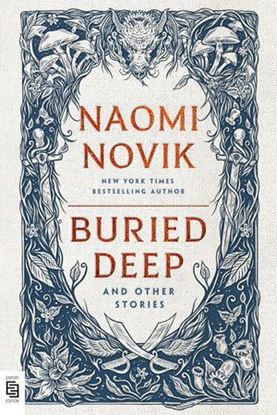
BURIED DEEP AND OTHER STORIES
From the dragon-filled Temeraire series and the gothic magical halls of the Scholomance trilogy, through the realms next door to Spinning Silver and Uprooted, this stunning collection takes us from fairy tale to fantasy, myth to history, and mystery to science fiction as we travel through Naomi Novik’s most beloved stories. Here, among many others, we encounter:
• A mushroom witch who learns that sometimes the worst thing in the Scholomance can be your roommate.
• The start of the Dragon Corps in ancient Rome, after Mark Antony hatches a dragon’s egg and bonds with the hatchling.
• A young bride in the Middle Ages who finds herself gambling with Death for the highest of stakes.
• A delightful reimagining of Pride & Prejudice, in which Elizabeth Bennet captains a Longwing dragon.
• The first glimpse of the world of Abandon, the setting of Novik’s upcoming epic fantasy series—a deserted continent populated only by silent and enigmatic architectural mysteries.
Though the stories are vastly different, there is a unifying theme: wrestling with destiny, and the lengths some will go to find their own and fulfill its promise.
995

995
THE SECOND COMING
When 13-year-old Jolie Aspern drops her phone onto the subway tracks in 2011, her estranged dad, Ethan, seems like the furthest thing from her mind. A convicted felon and recovering addict, Ethan has always struggled to see past himself. But then a call from his ex makes him fear their daughter's in deeper trouble than anyone realizes. Believing he's the only one who can save her, he decides to return to New York with a gift: the whole of his life, its hard-won triumphs and harrowing mistakes . . .
So begins the intimate epic of Jolie and Ethan: child and adult, apart and together, different yet the same. Their journey toward each other will face opposition from grandparents and siblings and friends. It will strain connections with roommates and benefactors and a probation officer desperate to help. It will push Jolie out past her depth with a mysterious admirer, and Ethan in over his head with his first love, Jolie's mom. But as father and daughter struggle to find their footing, new vistas beckon: from a surf break in mid-'90s Delaware to group therapy during the great recession, from an encampment at Occupy Wall Street to a HoJo on Maryland's Eastern Shore, from the heights of the Brooklyn Bridge to horizons seldom seen in fiction.
995
995
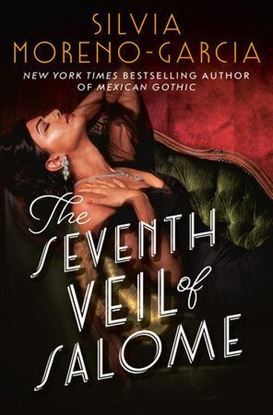
THE SEVENTH VEIL OF SALOME
1950s Hollywood: Every actress wants to play Salome, the star-making role in a big-budget movie about the legendary woman whose story has inspired artists since ancient times.
So when the film’s mercurial director casts Vera Larios, an unknown Mexican ingenue, in the lead role, she quickly becomes the talk of the town. Vera also becomes an object of envy for Nancy Hartley, a bit player whose career has stalled and who will do anything to win the fame she believes she richly deserves.
Two actresses, both determined to make it to the top in Golden Age Hollywood—a city overflowing with gossip, scandal, and intrigue—make for a sizzling combination.
But this is the tale of three women, for it is also the story of the princess Salome herself, consumed with desire for the fiery prophet who foretells the doom of her stepfather, Herod: a woman torn between the decree of duty and the yearning of her heart.
Before the curtain comes down, there will be tears and tragedy aplenty in this sexy Technicolor saga.
995
995
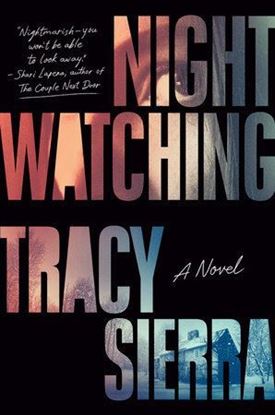
NIGHTWATCHING
Home alone with her young children during a blizzard, a mother tucks her son back into bed in the middle of the night. She hears a noise—old houses are always making some kind of noise. But this sound is disturbingly familiar: it’s the tread of footsteps, unusually heavy and slow, coming up the stairs.
She sees the figure of a man appear down the hallway, shrouded in the shadows. Terrified, she quietly wakes her children and hustles them into the oldest part of the house, a tiny, secret room concealed behind a wall. There they hide as the man searches for them, trying to tempt the children out with promises and scare the mother into surrender.
In the suffocating darkness, the mother struggles to remain calm, to plan. Should she search for a weapon or attempt escape? But then she catches another glimpse of him. That face. That voice. And at once she knows her situation is even more dire than she’d feared, because she knows exactly who he is—and what he wants.
995
995
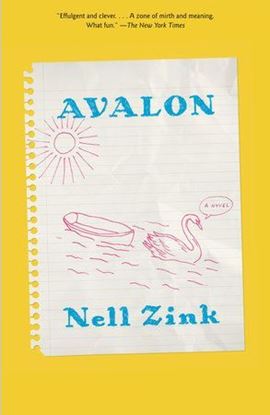
AVALON
Bran’s Southern California upbringing is anything but traditional. After her mother joins a Buddhist colony, Bran is raised by her “common-law stepfather” on Bourdon Farms—a plant nursery that doubles as a cover for a biker gang. She spends her days tending plants, slogging through high school, and imagining what life could be if she had been born to a different family.
And then she meets Peter, a beautiful, troubled, and charming train wreck of a college student from the East Coast, who launches his teaching career by initiating her into the world of literature and aesthetics. As the two begin a volatile and ostensibly doomed long-distance relationship, Bran searches for meaning in her own surroundings—attending disastrous dance recitals, house-sitting for strangers, and writing scripts for student films. She knows how to survive, but her happiness depends on learning to call the shots.
995

995
THE BEAUTIFUL AND DAMNED
Fitzgerald’s second novel, a devastating portrait of the excesses of the Jazz Age, is a largely autobiographical depiction of a glamorous, reckless Manhattan couple and their spectacular spiral into tragedy. Published on the heels of This Side of Paradise, the story of the Harvard-educated aesthete Anthony Patch and his willful wife, Gloria, is propelled by Fitzgerald’s intense romantic imagination and demonstrates an increased technical and emotional maturity. The Beautiful and Damned is at once a gripping morality tale, a rueful meditation on love, marriage, and money, and an acute social document. As Hortense Calisher observes in her Introduction, “Though Fitzgerald can entrance with stories so joyfully youthful they appear to be safe—when he cuts himself, you will bleed.”
995